
Gods who are animals.
Horus as falcon. Anubis as jackal. Thoth as ibis. Sekhmet as lioness. Read this as “symbolism” and you miss the essential. The Egyptian pantheon is no picture book — it is shamanism with state architecture.
Egyptian shamanism is the re-reading of ancient Egyptian religion as a shamanic tradition. The core markers are unmistakable: gods in animal form as power animals · the Pharaoh as divine incarnation · the threshold crossing into death as central initiation theme · the temple as ritual space with strict purity order · hieroglyphs and mantra syllables as carriers of ritual power. What Egyptology long described as “religion” is, on closer look, the same thing ethnologists document in circumpolar shamans — with a much larger apparatus. [Eliade 1951]
Egyptian religion is shamanism.
This is not a fashionable reinterpretation. Lay the three main hallmarks of shamanic traditions next to the Egyptian sources and the overlap leaves little room for doubt.
First: gods who are animals. In classical shamanic traditions, the practitioner works with power animals — wolves, bears, ravens, falcons. In Egypt the gods themselves are animal-headed or wholly animal. Horus as falcon. Anubis as jackal. Sekhmet as lioness. Thoth as ibis. Sobek as crocodile. Bastet as cat. That is no allegory · it is the shamanic ground view: animals carry power and are gate to it.
Second: Pharaoh as incarnation. The Pharaoh was not priest between gods and humans — he was himself divine incarnation · living Horus · son of Ra. The same structure shows up across many shamanic cultures: certain humans are not intermediaries · they are embodied spirit-being.
Third: the threshold crossing into death. The Book of the Dead · mummification · the psychopomp figure Anubis · the weighing of the heart at the throne of Osiris · the chambers of the underworld. Few cultures have structured death as a ritualized threshold passage as precisely as Egypt. That is shamanic core territory · full stop.
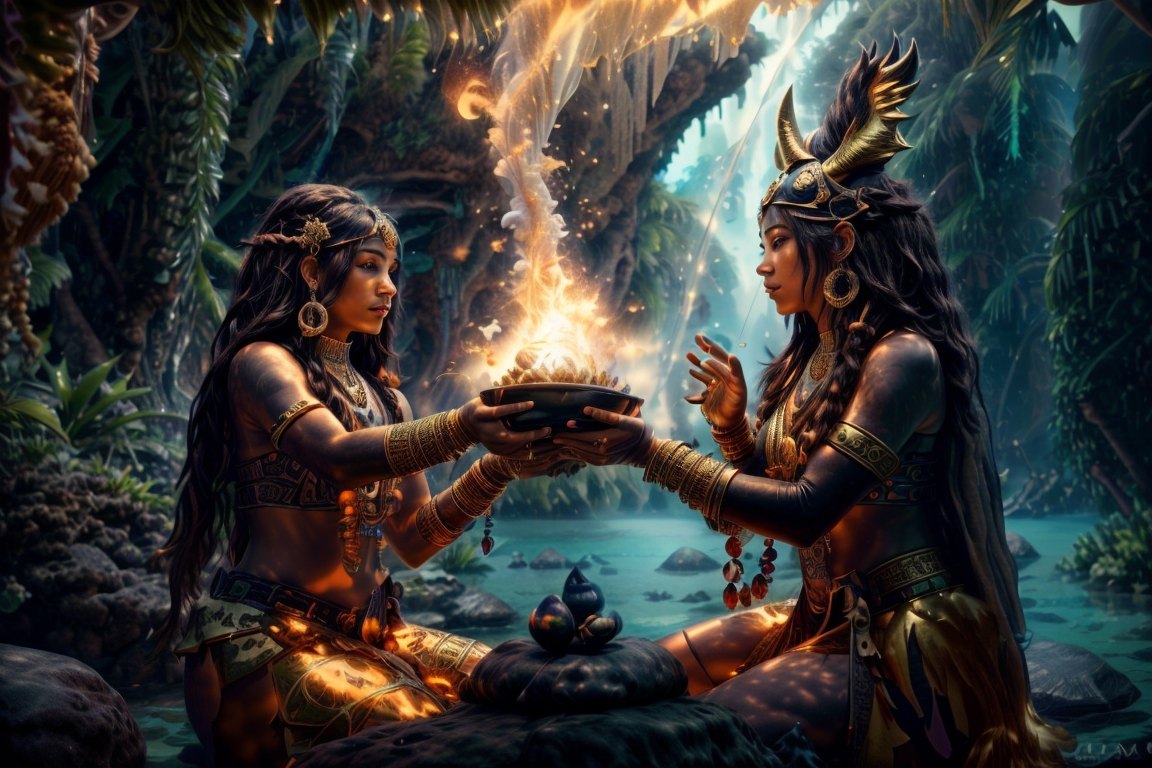
Four key gods.
Out of the vast Egyptian pantheon, four figures rise that open the deepest access in shamanic work.
Horus
The falcon. Sun and moon in his eyes — the Eye of Horus as sun-eye, as moon-eye. The union of opposites in one form. Striking parallel to the Siddham syllable HUM, which carries the same function in Asian rituals: sun-moon unity in a seed syllable.
Ra
The sun itself. Cleansing fire. Nocturnal voyage through the underworld and daily rebirth at the horizon. Remarkable: the syllable “Ra” carries in the Egyptian context the same cleansing fire-quality as the Siddham syllable Ra in Asian rituals — a pointer to deeper connections.
Osiris
The killed and reborn. Lord of the underworld. Weigher of hearts. Osiris stands for the great threshold crossing — death as initiation, judgment as clarification, rebirth as goal. No accident that almost every great mystery cult of antiquity carries Osiris motifs.
Anubis
The jackal. Psychopomp — guide of souls. Leads the deceased through the chambers of the underworld to judgment. In shamanic reading a classical power-animal jackal — direct access to border and death work, cemetery power, sharp scenting.
Pharaoh as incarnation.
Horus in life · Osiris in death
The living Pharaoh was Horus. The deceased Pharaoh became Osiris. Between the two states stood the funerary ritual — a precisely structured threshold crossing. Read the texts of the pyramids and sarcophagi: this is no theological wishful thinking · it is shamanic ritual with royal apparatus.
Temple as ritual space
Egyptian temples were not assembly halls. Only the Pharaoh and the priests entered the inner chambers. There the daily ritual work took place — feeding the divine images · cult of presence. The structure matches what shamanic traditions know as “the inner ritual space”: only the initiated enter.
Mantra and hieroglyph
Hieroglyphs are not just script. Certain syllables · certain sign combinations carry ritual power. The spoken sound · the written form · the magical effect — all flow together. Direct parallel to the Siddham syllables in the Asian ritual tradition and to the Futhark of the runes. Three cultures · one principle.
Coffin Texts and Book of the Dead
The Coffin Texts and the later compiled Book of the Dead are precise instructions for the threshold walk. Which formula does one speak at which chamber? Which being meets you and how do you answer? This is not poetry — this is a shamanic underworld map for the post-mortem journey.
Parallels to other traditions
The Egyptian motifs reappear in slightly modified form in the Mediterranean mystery cults · in the Hellenistic magic papyri · in early alchemical texts · and — remarkably — in the esoteric schools of Asia. The Siddham HUM syllable, the Ra syllable, the jackal as border-guard: read all traditions together and you see connections that academic disciplines only hesitantly name.
Egyptian shamanism at a glance.
Animal gods
Power animals in divine form. Falcon · jackal · lioness · ibis · crocodile. Each animal a gate to a concrete force.
Ankh
The sign of life. Life force · immortality · spiritual energy. One of humanity's oldest key symbols.
Eye of Horus
Sun and moon in one form. Protection · healing · supernatural seeing. The eye that looks through · not merely at.
Djed pillar
The spine of Osiris. Stability · uprightness · the inner axis. The ground every threshold walk requires.
Feel the Egyptian lineage.
The free perception test shows you whether the Egyptian gods are calling. On the Master Path you walk it concretely — with ritual · altar · animal-god work · and the experience of what the ancient texts always meant.