The Spiritual Warrior
in Shamanism
Wolf, ninja, Ogou, Bagua, Horus · a map of warriorhood that does not aim at violence but at walking through fear.
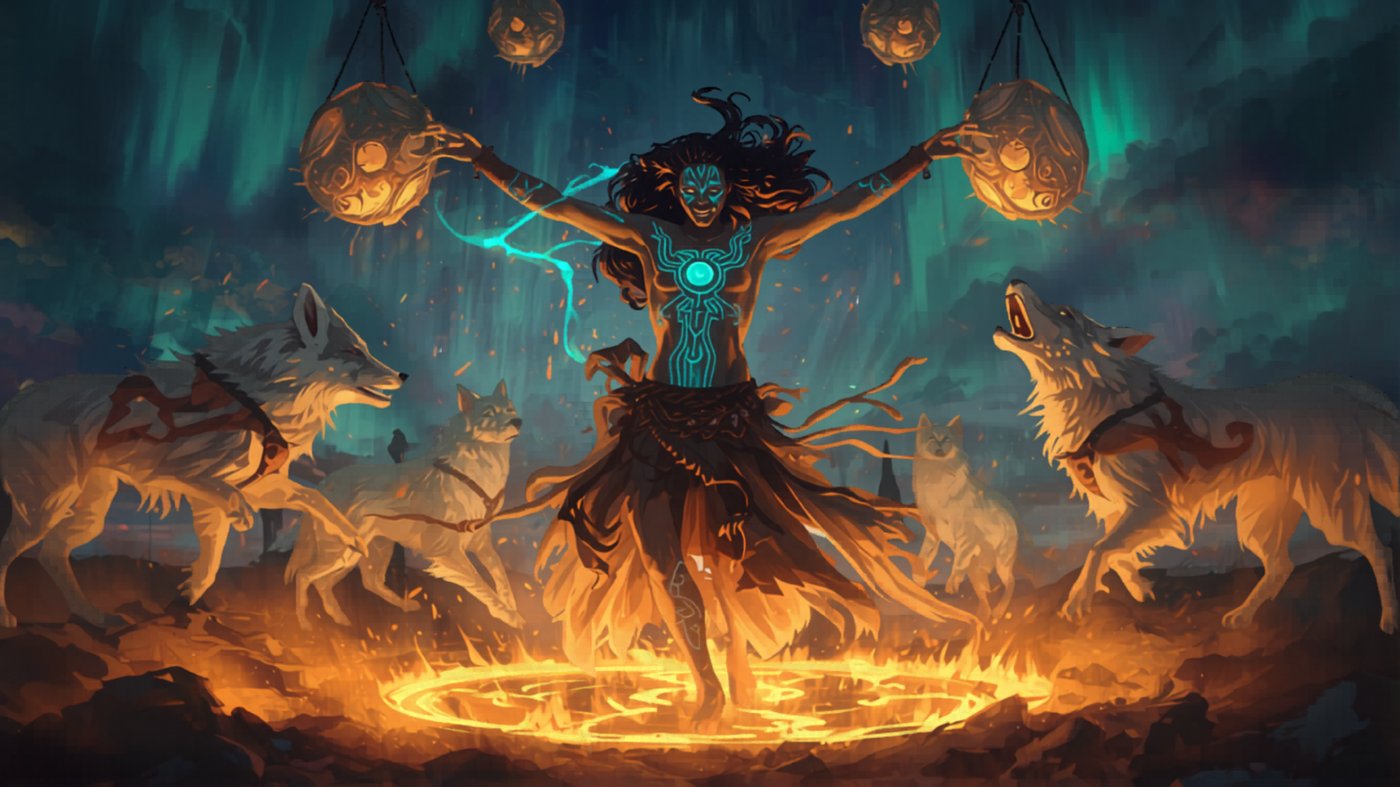
The word "warrior" sounds suspect to Western ears. It evokes the battlefield, conquest, a masculinity fallen out of time. What gets lost: warrior was a spiritual rank in almost every shamanic culture. Not a profession, not an honorific, but an initiation. Whoever was addressed as warrior had walked through something — something most people avoid all their lives. They had looked their own fear in the face and not stopped there.
This text is the overview article for the theme. It outlines the core idea of spiritual warriorhood across cultures that never met and yet found astonishingly similar answers. The individual traditions touched below each have their own articles. Here we are after the pattern that connects them.
What a spiritual warrior is
A spiritual warrior is someone who has united three things in themselves: strength, wakefulness, and devotion. Strength without wakefulness is violence. Wakefulness without strength is passive observation. Devotion without the other two is sentimentality. Only the connection of all three makes a warrior.
In each tradition considered here, these three elements stand at the centre. The images differ — a wolf, a jackal, a falcon, a shadow in the dark, a rider on the red horse — but the structure is the same. Strength, wakefulness, devotion.
What does not belong to spiritual warriorhood: dominance over others. Whoever needs their strength to make others small is not a warrior — they are wounded and do not know their wound. That is a hard statement, but it holds in every shamanic culture. The warrior's work begins at one's own shadow, not at the opponent.
The warrior's first opponent is their own fear. Every other opponent is secondary — and often projection.
East Asia · the ninja and the mountain ascetic
The Japanese tradition knows the ninja not as a mercenary but as someone who emerged from the mountain ascetics of Shugendō. The roots reach back into the shamanic-Daoist space, where the nine syllables of Kuji Kiri arose — originally as protective formula on entering animated mountains, long before they landed in a fighter's hand.
The ninja carried forces an ordinary samurai did not: knowledge of breath, of hand signs, of spirit allies, of camouflage as meditative practice. Whoever moves in absolute stillness must first have walked through their own unrest. That was the real test, not the physical technique.
Parallel to him stands the Yamabushi, the mountain ascetic himself, who never became a mercenary and yet shares the same tools. Both paths — the hidden and the open — root in the same ground. See the spoke article on ninjutsu and shamanic magic.
East Asia · the Bagua rider and the inner circle
Bagua Zhang, the "eight-trigram palm", is known in the West as a Chinese martial art. That misses the core. Bagua is Daoist body work walked in a circle. The circle is not decoration — it is the image of the world. The walker does not walk against someone; they walk around a centre that is themselves.
In shamanic Daoism, Bagua is a technique of trance. The walking shifts perception, the circle opens another space. The use as a martial art is a side effect. Whoever truly works with Bagua first learns to see the world from inside, before learning to order it outwardly.
Tai Chi follows the same pattern, only softer, less outwardly conspicuous. The form is a choreography that leads the body into a specific state of consciousness. That too is warrior's work — only one that needs no witnesses.
Qigong, finally, is not esoteric gymnastics but the methodology of the warrior's body. Breath, posture, visualisation, intention — worked out by Daoist shamans, refined through centuries of practice. Whoever takes Qigong seriously works at the Dantian, at Jing, at Shen — three terms behind which stands the same reality the wolf shaman also knows, naming it differently.
Caribbean and Africa · the Loa of fighting energy
Haitian and West African voodoo does not know an abstract warriorhood — it knows beings that embody this force. Each has its face, its colour, its rhythm.
Ogou (also spelled Ogun) is the iron Loa. Blacksmith, warrior, force of work, of decision, of the cut. Whoever is touched by Ogou discovers the boundary in themselves — inwardly as well as outwardly. Ogou is not brutal. Ogou is clear. And this clarity is for many Western-socialised people the harder experience than any physical exertion.
Erzulie Dantor, the black mother Loa, is the other side of this force. She protects what is entrusted to her with a ferocity that touches the edge of the bearable. Whoever works with Erzulie Dantor gets to know the mother as warrior — a figure completely foreign to the Western-Christian image of the mother and yet deeply familiar once felt.
The Ghede Loa around Baron Samedi are their own kind of warriors: threshold guardians, ancestor-callers, laughers in the face of death. The warrior who works with Ghede does not fight against death — they dance with it. That changes everything. Whoever can laugh while death sings along has disarmed the warrior's deepest opponent.
The Petro Loa, including especially Marinette, embody an untamed, hot force — the energy of breaking forth, of rupture, of liberation. Marinette is linked in Haitian history with the tearing-loose from slavery. This is not gentle energy. It is called in practice with respect and clear frame, not lightly. But she belongs on every map of spiritual warriorhood because she embodies the moment in which something breaks through that was held too long.
Egypt · the falcon Horus and the jackal Anubis
The Egyptian tradition knows two great warrior figures. Horus, the falcon, son of Isis, is the avenger of his father Osiris. His eye — the famous Wedjat — stands for wakefulness in the warrior sense: see before being seen. Horus fights Seth, the lord of chaos. But the fight is not annihilation; it ends in an ordered cosmos in which both forces have their place.
Anubis, the jackal, is the silent warrior. He does not fight with weapons, he watches. He guides souls through the passage. He weighs the heart. He is the warrior as gatekeeper. In the system invoked below — the Great Wolf in three cultural spheres — the jackal stands as the African aspect of the same animal that appears in Japan as Ōkami.
Northern Europe · the wolf warrior
The wolf shaman stands in the lineage central to Shamanic Worlds. To be a wolf warrior means: think in the pack, know your territory, endure the silence of winter, stay silent at the right time, strike at the right time. It also means: take on the qualities of the wolf without imitating it.
The wolf is not a dog that is barked at, nor a predator that only eats. He is a being with complex social order, great gentleness toward his own and great hardness against what threatens the pack. That makes him the ideal mirror for someone consciously entering warrior existence. The spoke article on the wolf warrior initiation goes deeper.
The energy behind all traditions
However different the images — wolf, falcon, jackal, ninja, Ogou, Bagua rider — the force flowing through them carries a different name in each culture. In Japanese, Ki. In Chinese, Qi. In West African, Ashe or Ase. In Egyptian, Sekhem. In European shamanic languages often simply "force" or "breath".
The names differ. The effect is similar enough that those practised in one tradition recognise the other once they meet it. That is one of the reasons a truly practised path — whichever — makes a person more permeable to other paths, not more closed.
What distinguishes the warrior from the fighter
A fighter wants to win. A warrior wants to do justice. That is not a play on words, it is the whole difference. Doing justice means: to the situation, the counterpart, one's own path, what must be done in the moment. Winning is a category of the ego. Doing justice is a category of the soul.
That is why a spiritual warrior can also lose — and remain a warrior. That is why they can stay silent when everyone speaks, and remain a warrior. That is why they can weep when the situation calls for it, and remain a warrior. This freedom is the gain of initiation. It is not negotiable.
The path at Shamanic Worlds
In the wolf shamanic lineage Dr. Mark Hosak transmits, several of these strands flow together. The Wolf Shaman Master Path is the heart-piece — here the warrior theme is initiated in the context of wolf work. The ninjutsu lineage, in which Mark is the successor of Taguchi Sensei, opens the Japanese strand: Kuji Kiri, Gotonpo, the inner techniques. The voodoo initiation complements the Loa strand. Bagua Zhang and Qigong elements flow into the practice of inner alchemy.
This is no eclectic collection. Each strand is honoured within its own frame. But initiation in one tradition opens an ear for the others that was previously deaf. That is one of the unexpected fruits of a seriously walked path.
Tengu Akasha Dōjō · the lineage for bodily transmission
Whoever wants to walk the bodily-technical strand of spiritual warriorhood will find it at the Tengu Akasha Dōjō. There Dr. Mark Hosak leads the ninjutsu of his lineage — including Kuji Kiri, Gotonpo, and the energetic foundations. The shamanic depth stands at Shamanic Worlds, the bodily form at the Dōjō. Both complement each other.
tengu-akasha-dojo.deWalk the path of the spiritual warrior
The Wolf Shaman Master Path initiates the warrior aspect in shamanic depth. The Tengu Akasha Dōjō complements the bodily side. Both belong together.