
Karma is the principle that actions, words, and thoughts carry consequences — over time, sometimes across lifetimes. The term comes from Sanskrit (कर्म) and literally means "deed" or "action." In the Buddhist, Hindu, Daoist, and shamanic traditions, karma has been described for millennia as a central concept of spiritual life. Karma is not a punishment system. It is a description of the subtle connection between action and effect — not a moral threat.
I'm Dr. Mark Hosak. I earned my PhD at Heidelberg University on Buddhist healing rituals, spent three years researching in Kyoto's temples, practiced on the sacred mountains of Koyasan (Shingon) and Hieizan (Tendai), walked the Shikoku pilgrimage on foot, and have had encounters with spiritual masters on travels through Japan, Korea, and Southeast Asia. Over ten years ago I took on the Wolf Shamanism lineage of the Ivory Coast via Baron Samedi — and have worked daily with karmic themes in counseling and accompaniment ever since.
What Karma Is Not
Karma is not "you were bad, now you must suffer," not justification for "you brought this on yourself," not fixed fate, and not instant punishment. In authentic traditions karma works over long periods, often subtly, never as a 1:1 form of "harm for harm." Karma describes the functioning principle of reality — not a moral threat.
The popular Western reading of karma is a mixture of Western guilt-tradition and simplified Indian esotericism. Before going deeper, let's sort out what karma is not.
Not "you were bad, now you must suffer." That's a Western guilt-logic transferred to an Eastern term. In authentic Buddhist traditions, karma is neither punishment nor reward — it's a description of how reality functions.
Not justification for "you brought this on yourself." When someone tells you "your cancer is your karma" or "your poverty is your karma," that's a Western distortion. In authentic traditions, karma is not used to justify individual tragedies. It's observation of patterns, not accusation.
Not fate. Karma is movable. In Buddhist traditions it's emphasized that karmic patterns can be changed through awareness, practice, ethical action. There's no fixed punishment for past doing.
Not a simplified reincarnation doctrine. Even though karma in many Eastern traditions is connected with rebirth concepts, the two concepts are not identical. You can think about karma without holding any particular model of rebirth.
Not instant punishment. The pop-phrase "Karma is a bitch" — when something bad quickly happens to someone after a bad action — is a Western shortening. In authentic traditions, karma works over long periods, often subtly, often not in the direct 1:1 form of "harm for harm."
Karma in the Buddhist Tradition
In the Buddhist tradition whose roots I researched at Heidelberg University, karma is not a moral reward-and-punishment system. It is a description of how reality functions.
In the Mahayana tradition, to which Mikkyō belongs, karma is understood in several layers:
First: immediate karma. The direct effect of an action — when I say a sharp word to someone, I get a reaction. Clear, visible, immediate.
Second: mediate karma. The effects that build over days, weeks, months. What you think today shapes your habit-patterns for tomorrow. What you are today disposes you for the day after.
Third: latent karma. The deep patterns laid down in your system — by upbringing, by experience, sometimes in Buddhist traditions also by earlier existences. These latent patterns show themselves when conditions allow.
Important: karma in the Buddhist tradition is always connected with mindfulness and conscious practice. It's no accusation — it's an invitation to conscious action.
Karma in Mikkyō and Mark's Heidelberg Research
In Mikkyō, the esoteric Buddhism of Japan, karma is understood especially subtly in the context of visualization and mantra practice. What Kūkai (Kōbō Daishi) brought from China to Japan in the 9th century was a system in which karmic patterns are not only observed, but also transformed — through concrete ritual practice.
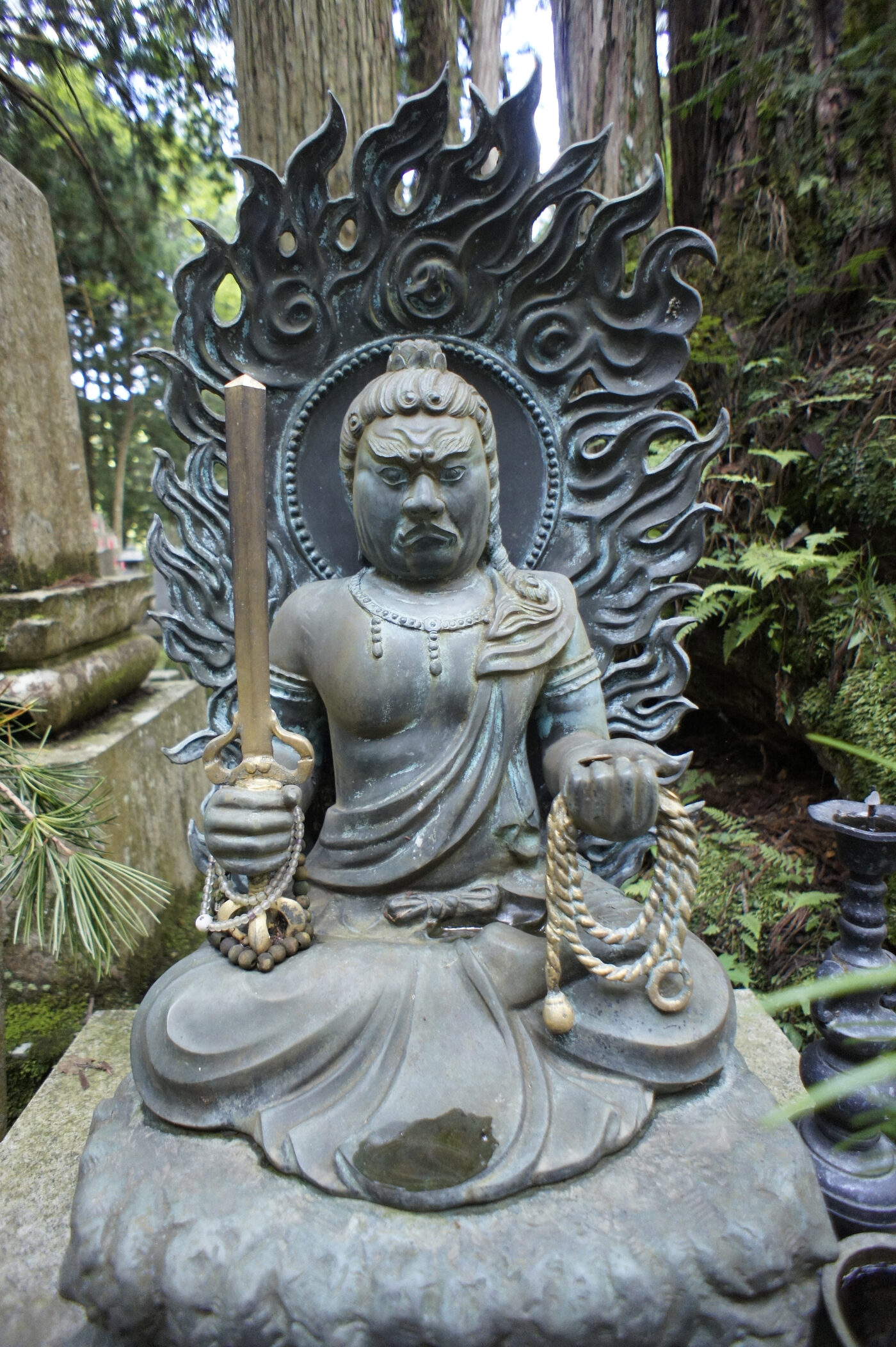
The central practice is Sokushin jōbutsu 即身成仏 — literally "becoming Buddha in this body." The concept behind it: karmic patterns are not walled in. Through deep practice — visualizations like Gachirinkan (moon disk meditation, see Full Moon page), mantra recitation, ritual hand positions (mudras) — even deep karmic layers can come into movement.
My Heidelberg dissertation engaged with the Siddham characters central to such practice in the Mikkyō tradition. Each Siddham syllable carries a specific karmic effect-layer. The practice with them — the ritualized calligraphic practice, the visualization, the invocation — can bring karmic patterns into movement, set new patterns, deepen spiritual development.
This isn't self-help esotericism. It's a strictly structured ritual practice transmitted in the Shingon temples of Japan for over 1,200 years. Anyone practicing in this tradition deepens over time in working concretely with karmic layers — not just talking about them.
Karma in Daoism
In Chinese Daoism there's a related concept — even though the word karma isn't used. Instead Daoism speaks of Yin and Yang, of the flow of Qi, of inner patterns that can be transformed.
The Daoist position: every being is part of a flowing balance. What you do influences this balance — both in yourself and in the world. Whoever acts against the Dao (against the natural order) creates tensions that must be resolved later. Whoever acts within the Dao builds harmony.
In inner alchemy (Neidan, 內丹) there are concrete practices for working with one's own energetic patterns. What the Buddhist tradition describes as "karmic layer," Daoism often describes as "Qi blockage" or "unresolved tension." Both views are related.
In my own Bagua and Daoist practice I work with the moon cycle (see Moon Phases page) — the waxing phase is accumulation (Yang movement), the waning phase is letting go (Yin movement). Karmic themes ready to release can be consciously handed over especially well in the waning phase.
Karma in the Wolf Shaman Lineage of the Ivory Coast
My Wolf Shamanism comes from West Africa — more precisely, from the Ivory Coast, via Baron Samedi. This clarification is laid out in full on the Full Moon page and the Wolf Shamanism page.
In this tradition the concept "karma" is framed differently. There's no strictly systematic karma tradition like in Buddhism or Hinduism. Instead, much is worked with ancestor themes — and with the concept of "dette," the debt between worlds.
The idea of "dette": what you do builds layers of relationship — to ancestors, to Loa, to people, sometimes to places. Some of these layers are unbalanced. There's something that still must be given — an acknowledgment, an attention, a ritual honoring. As long as this layer isn't balanced, it works as binding in the background of your life.
What your forebears experienced, suffered, did, can show in your system as pattern. If your grandparents experienced trauma that wasn't processed, this trauma can appear in you as symptom — anxiety, relationship patterns, bodily sensitivity. In the Vodou tradition, work with ancestors is central — ancestors are honored, called, sometimes also freed when they're bound.
What does that mean practically? When someone comes to me in accompaniment with patterns that seemingly have nothing to do with their own biography — but sit deep — I often look in the direction of the ancestor lineage. What has your family experienced over generations? What themes are unprocessed? What loyalties are unresolved? What "dette" still stands open?
This isn't therapeutic treatment in the medical sense — it's spiritual work that can run parallel to therapeutic work. Anyone with severe psychological themes belongs in qualified therapeutic care.
More on the Vodou tradition on the Voodoo page.
Karma as Ma'at — The Egyptian Counterpart
In the ancient Egyptian tradition that Eileen Wiesmann engages with religion-historically, there's a related concept: Ma'at (𓆄). Ma'at refers to cosmic order, balance, truth. Whoever lives in accord with Ma'at builds order. Whoever acts against Ma'at creates imbalance — that must later be balanced.
The most famous image: the weighing of the heart in the death court. After death the heart of the deceased is weighed against Ma'at's feather. What's too heavy — through unbalanced actions — cannot pass into the next layer of existence. What's light — through life in accord with order — moves on.
This isn't a moral reward system in the Western-religious sense. It's a ritualized description of what all karma traditions say: your actions form the layer in which you move after death. In Buddhism this layer is rebirth. In the Egyptian concept it's the passage to the beyond. In Vodou it's the relationship to the ancestors you become.
The Egyptian threshold deity of these passages is Anubis — the golden jackal god who guides the deceased through the underworld and oversees the heart-weighing. In my comparative research, Anubis connects functionally with Baron Samedi in the West African tradition — both are threshold guardians, both know the orders beyond the visible.
Karma and Aura — The Perceivable Aspect
Anyone who trains aura perception (see Aura page) develops over time the ability to recognize karmic patterns in the aura.
Certain themes — when they're deep and unprocessed — show themselves as atmospheres in the aura. Anyone trained in aura perception can read this — without telling the client "you have bad karma." What you say: "Here is a theme that wants attention."
This aura-karma connection isn't universally recognized in all traditions. It's part of my own practice synthesis from Mikkyō, Daoist, and Vodou elements.
How Karma Works in Your Life
Karma isn't an abstract concept. Anyone who looks at it seriously recognizes concrete traces in their daily life — typically in five fields.
Relationship karma. You attract the same type of partner again and again. The stories differ, but the dynamic is the same. You get the same conflicts with different people. The same wound-pattern repeats — with parents, then with partners, then with bosses. That's no streak of bad luck. It's a karmic pattern waiting to become conscious.
Career karma. You land again and again in constellations where you make yourself small, are exploited, your gifts don't come to bear. Or the reverse: in constellations where you always carry the responsibility others give up.
Health karma. Certain bodily themes appear again and again without a clear medical cause being graspable. Certain places in the body are chronically burdened. In shamanic perception such themes often have an energetic layer parallel to the bodily one. Important: this doesn't replace medical clarification. Anyone with bodily complaints goes to the doctor first.
Family karma. You carry themes that don't come from your own life. Preferences, anxieties, loyalties you can't explain. In the shamanic reading these are often ancestor traces — lineages running through your family showing themselves once more in you. The Vodou tradition knows concrete tools for acknowledgment and resolution.
Place karma. Some places show themselves as energetically charged. Battlefields, old temples, places with unprocessed histories. Karmic effect isn't only biographical — it lies also in places, in objects, sometimes in images.
How karmic patterns show themselves. Typical markers: synchronicities that don't feel coincidental. Recurring dreams with similar images. Sudden encounters with people that trigger something you can't explain. A strong attraction or repulsion to a person at first glance. Themes that in different life phases with different people carry the same dynamic.
Karma in Relationships — Soul Connections and Karmic Partners
One of the most common questions in my accompaniment work: "Was that a karmic relationship?"
The pop-spiritual answer: every relationship with strong attraction is karmic. That's not right. What's understood as karmic relationship in the narrower sense has clear markers.
What a karmic relationship really is. A karmic relationship is an encounter with a person you share an unbalanced energy-layer with. Something laid down in an earlier constellation — biographical, ancestor-energetic, in Eastern traditions sometimes also pre-existential — and now coming to encounter.
The markers of a karmic connection: First encounter feels like recognition. Strong intensity from the beginning. Recurring conflicts that can't be resolved, even though both want it. Difficulty ending the relationship even when it's clearly unsatisfying. After separation: persisting energetic connection. You think about the person for years, dream of them, feel connection even though you long don't see them.
Difference: karmic connection — soul mate — twin flame. In my reading synthesis:
A karmic connection is an encounter with unbalanced backstory coming to resolution. It can be harmonious or conflict-laden. It has a beginning and an end. It ends when the layer is balanced.
A soul mate is a person whose consciousness architecture harmonizes with yours. With them you build coming-home. Soul mates can be partners but don't have to be.
A twin flame in pop usage is a controversial concept. What occurs in my practice: extremely rare encounters where two people mirror each other in deepest layer. These encounters aren't necessarily beautiful or harmonious — they're transformative in a way not everyone wants to go.
When a karmic relationship is complete. The pop answer: "When you no longer feel pain." The shamanic answer is different: a karmic relationship is complete when the pattern behind it is dissolved. You can encounter the person — on the street, in a café — and nothing deep moves. Not because you've become indifferent, but because the layer is balanced.
Karma vs. Fate — The Important Difference
In pop usage, karma and fate are often mixed. "It's just my karma" gets said the same way as "It's just my fate." That's imprecise and leads to a more resigned attitude than necessary.
Karma is movable. Karma are traces you yourself have set — through actions, words, thoughts — that work back. What you've set, you can also transform. Karma is material you work with.
Fate in the strict sense are unavoidable constellations — the country you were born in, the body you have, the parents you didn't choose, the time period you were born into. With fate you can't negotiate. You can only shape your answer to it.
Free choice lies between. You're not free in what was given to you. You're free in what you make of it. That's the Buddhist attitude in a simple formulation. And it's the shamanic attitude in a different language.
Why "everything is karma" is a dangerous oversimplification. If you push every tragedy onto karma, two things happen at once: first, you make yourself the guilty one for something that perhaps wasn't even in your hand. Second, you relieve perpetrators — when someone does violence to you, that wasn't "your karma." That was violence. Period.
Karma as Perception Practice, Not Guilt System
The most important position I want to advocate on this page: karma is a perception practice, not a guilt system.
The Western distortion — karma as cosmic punishment — comes from a Western-religious moral tradition that has little to do with the authentic karma concepts. In that guilt tradition there are sins to be punished. In the karma tradition of the Buddhist world there are actions carrying effects — but "sin" and "punishment" are not the right words.
What karma in the authentic traditions really is:
A practice of awareness. Anyone who understands karma pays more conscious attention to their actions, words, thoughts — not because they fear, but because they understand the connection between action and effect.
A practice of responsibility. Anyone who understands karma takes responsibility for their life — not in the sense of "everything is my fault" but in the sense of "my responses co-shape my reality."
A practice of patience. Anyone who understands karma stops expecting instant results. Some karmic patterns need years, sometimes generations, to dissolve.
A practice of humility. Anyone who understands karma stops judging others. What you don't know are the layers in which the other's life runs.
Karmic Entanglements — What Are They?
A term that often appears in spiritual language is "karmic entanglement." In my reading synthesis: a karmic entanglement is a lasting energetic connection with a person, theme, or place — that isn't dissolved and that binds your life force.
Examples from practice: a relationship long over but still occupying you. A quarrel with a family member never cleared up. A place where something terrible happened to you, gripping you inside today when you come near. A family trauma over generations showing as recurring pattern in your life.
These entanglements aren't merely psychological. In shamanic perception they're energetically real — visible in the aura, palpable as binding, sometimes visible as actual link with another person or place.
What to do with karmic entanglements?
In the Mikkyō tradition: concrete practice — visualization of the entanglement, conscious handing over to the cleansing of the moon disk, releasing in a ritual form.
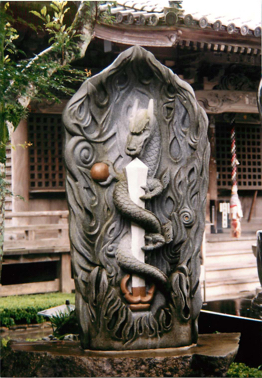
In Kuji Kiri, the Nine-Cuts practice from Shugendō and the esoteric-Buddhist tradition of Japan, there's a particularly powerful form of karmic clearing. The Nine Cuts are set with mudras, mantras, and visualizations — and they work on the energetic layer. Goshinbō (護身法) — the practice of self-protection — is a central component. This practice isn't anime folklore. It's a real, transmitted threshold discipline. At the live events Kuji Kiri 1 and Kuji Kiri 2 (see events) this practice is concretely transmitted — with focus on karmic clearing. The figure with whom the cutting practice is connected is Fudō Myōō (不動明王) — the immovable wisdom king who with sword cuts the bindings and with lasso pulls out what no longer needs to be carried.
In the Vodou tradition lies another, very direct form: invocation of Baron Samedi and the protection forces, ritualized threshold work, concrete rituals for resolution and protection.
This all needs accompaniment — not because it's dangerous, but because untrained self-work often stays at the surface.
Karma in Shamanic Group Practice
When someone comes to me with a karma theme — in a live event, in a Master Path session, in the Master Path's VIP tier — the work doesn't follow a fixed scheme. It's an encounter, not a procedure. Still there's a typical arc — and concrete tools.
The typical arc: first read diagnostically, then clear concretely. The first phase is diagnostic. What shows itself? Which layer carries the theme? Is it relationship karma, ancestor karma, place karma, an open "dette"? The second phase is concrete clearing work. Here come the ritual tools — Kuji Kiri, Vodou rituals, Mikkyō practice.
Reading tools: Aura reading. The central diagnostic tool (see Aura page) — recognizing karmic layers as atmospheres, heaviness, energetic bindings to people or themes.
Tarot as ritualized reading. Tarot in my practice is no fortune-telling tool. It's a ritualized form in which images from the unconscious can emerge.
Drum journey. In the Wolf Shaman lineage of the Ivory Coast the drum is central. While I drum, another perception layer opens.
Direct perception. Over years a direct form of perception develops in shamanic practice — you know something without being able to say from where.
Realistic expectations. What I can offer is accompaniment. No healing. No guarantee. What I can pass on from my lineage is a perception practice and concrete shamanic tools — they have their own value, alongside other support offerings.
Karma in Anime — What Naruto, Demon Slayer, JoJo, Death Note Show
Karma isn't only alive in the ancient texts. In Japanese animation the concept appears again and again — often more precisely than in Western films, which think more in black-and-white morality.
Naruto. Sasuke carries the karma of his brother Itachi and his entire Uchiha clan — a generational layer he didn't himself lay down, but that shows itself in him. The series shows clearly how karmic traces work over families, over teacher-student relationships, over old pacts between villages — and how they can only be dissolved through awareness and concrete acknowledgment, not through victory in battle.
Demon Slayer (Kimetsu no Yaiba). Each demon carries a karma story from their human time — usually unprocessed trauma, loss, anger. The series shows this with unusual clarity. Tanjiro's stance — compassion even in battle — is Buddhist karma ethics in anime form.
JoJo's Bizarre Adventure. The Joestar lineage is a karmic web running over generations. What Jonathan Joestar set in motion against Dio runs through all subsequent generations — until Jolyne, Josuke, all Stand users. The series shows karmic lines as real structuring force, not as metaphor.
Death Note. Light Yagami begins with a seemingly just action — killing criminals to better the world. The series shows with frightening precision how a single action layer triggers a karmic spiral from which there is no escape. Death Note is the Buddhist karma teaching as tragedy — and it shows why "the end justifies the means" karmically doesn't work.
Mushishi and Natsume's Book of Friends. Both series show encounters in which open karmic layers are recognized and dissolved with acknowledgment. That's shamanic karma work in anime form: not battle, not banishment, but making visible and releasing.
What East-influenced storytelling shows better than Western films: that characters carry layers in themselves not from their own lives — from family lines, from old conflicts between worlds, from open vows. That antagonists often have their own karma stories making them not villains but beings with a wound. That resolving a conflict happens not through victory but through acknowledgment of what both carry.
Karma and Moon Phases
Even though karma isn't time-dependent, there are practice anchors in the moon cycle that can support karmic work (see Moon Phases page):
1 · New Moon
Seed phase for new patterns. Set a clearing intention — consciously, quietly, without expectation. What do you want to clear in this cycle?
2 · Waxing Moon
Building of perception. What becomes visible in your patterns? Keep a journal.
3 · Full Moon
Maximum of perception sharpness. Gachirinkan meditation or other visualization. Threshold work (see Full Moon page).
4 · Waning Moon
Release phase. Concrete handing over — thread into fire, written holding and symbolic transferring.
Over several moon cycles karmic work becomes concrete. This isn't a quick fix. It's slow, deep work.
Mark's Own Karma Path
If someone asks how I got to what I do today, the honest answer: it wasn't my decision in a linear sense. It was a series of encounters that look in hindsight like a line.
Already as a child: a fascination for Asian characters and finger signs in old films, long before I understood what they were. I knew in my heart something true was there. That wasn't preference. That was recognition.
The Heidelberg doctorate was the academic answer to this childhood perception. Three years of research in Kyoto. Practice and research in temples of the Shingon, Tendai, and Zen schools. The Shikoku pilgrimage walked on foot — 88 temples.
The second large layer came later: the transmission of the Wolf Shaman lineage of the Ivory Coast. Two dreams in one night — Baron Samedi with wolf fur, the wolf pack. The recognition that something new was beginning that I hadn't sought.
Honest Disclaimer
An important clarification: my work with karmic themes is not therapeutic treatment in the medical sense. It replaces no psychotherapy, no medical treatment, no psychiatric care.
Anyone with severe psychological themes — depression, anxiety disorders, trauma sequelae — belongs in qualified therapeutic hands. What I offer is spiritual accompaniment parallel to or independent of therapeutic work.
I promise no healing of illnesses through karmic clearing. I promise no guarantees. What I offer is an old perception tradition with tools that have their own value — alongside, not instead of, other support offerings.
Practice Entrances for Karmic Work
If you've come this far and notice the theme won't let you go, there are four entrances — sorted from easily accessible to the full path.
First Step · Newsletter and High-Sensitivity Quiz
The easiest entrance. If you wonder whether your perception is connected with high sensitivity — which is the case for most karmically searching people — take the short quiz "Are you highly sensitive?". Afterward you can subscribe to the Shamanic Worlds newsletter.
Hearing and Letting In · Shamanic Worlds Podcast
The Shamanic Worlds Podcast offers regular deepening — including on karmic themes. More on the Podcast page.
Deepening · Aura Chakra Magic, Kuji Kiri Live Events, Japanese Grimoire Society
For those who already know that concrete practice is right, several direct entrances:
Aura Chakra Magic deepens the aura and chakra work in which karmic layers become visible and workable. Aura Chakra Reading opens the perception and diagnosis practice. The Kuji Kiri 1 and Kuji Kiri 2 live events transmit the Nine-Cuts practice as a tool for concrete karmic clearing.
The Japanese Grimoire Society on Skool is the English-speaking community for Kuji Kiri practice — the most direct entrance for English speakers into the karmic clearing tradition.
Japanese Grimoire Society on Skool Aura Chakra Magic
Related entrance · Shingon Reiki. Those drawn to the Shingon healing tradition find on shingon-reiki.com the parallel project — healing practice from the same Bonji-Siddham tradition.
Depth Path · The Two Master Paths
For those who want to enter long-term shamanic accompaniment, there are two equivalent paths with different focuses. The Wolf Shaman Master Path (Wolf Shamanism of the Ivory Coast via Baron Samedi, Mikkyō depth, three tiers including VIP 1:1 sessions) and the Shingon Reiki Master Path (the contemporary transmission of the Shingon healing tradition with Bonji-Siddham practice). Both equivalent, with different focuses.
Wolf Shaman Master Path · Shingon Reiki Master Path
Japanese Grimoire Society — Kuji Kiri community
The English-speaking community for Kuji Kiri practice on Skool. The Nine-Cuts as threshold discipline for karmic clearing — transmitted in the lineage.
Join Japanese Grimoire Society The Master Path