Protection in Wolf Shamanism ·
Eight Qualities Across Three Cultural Spheres
The wolf protects because he is awake · because he knows boundaries · because he holds the pack together in front and behind. Ofuda at Mitsumine, wolf cross in Iceland, Loup de Baron at the threshold.
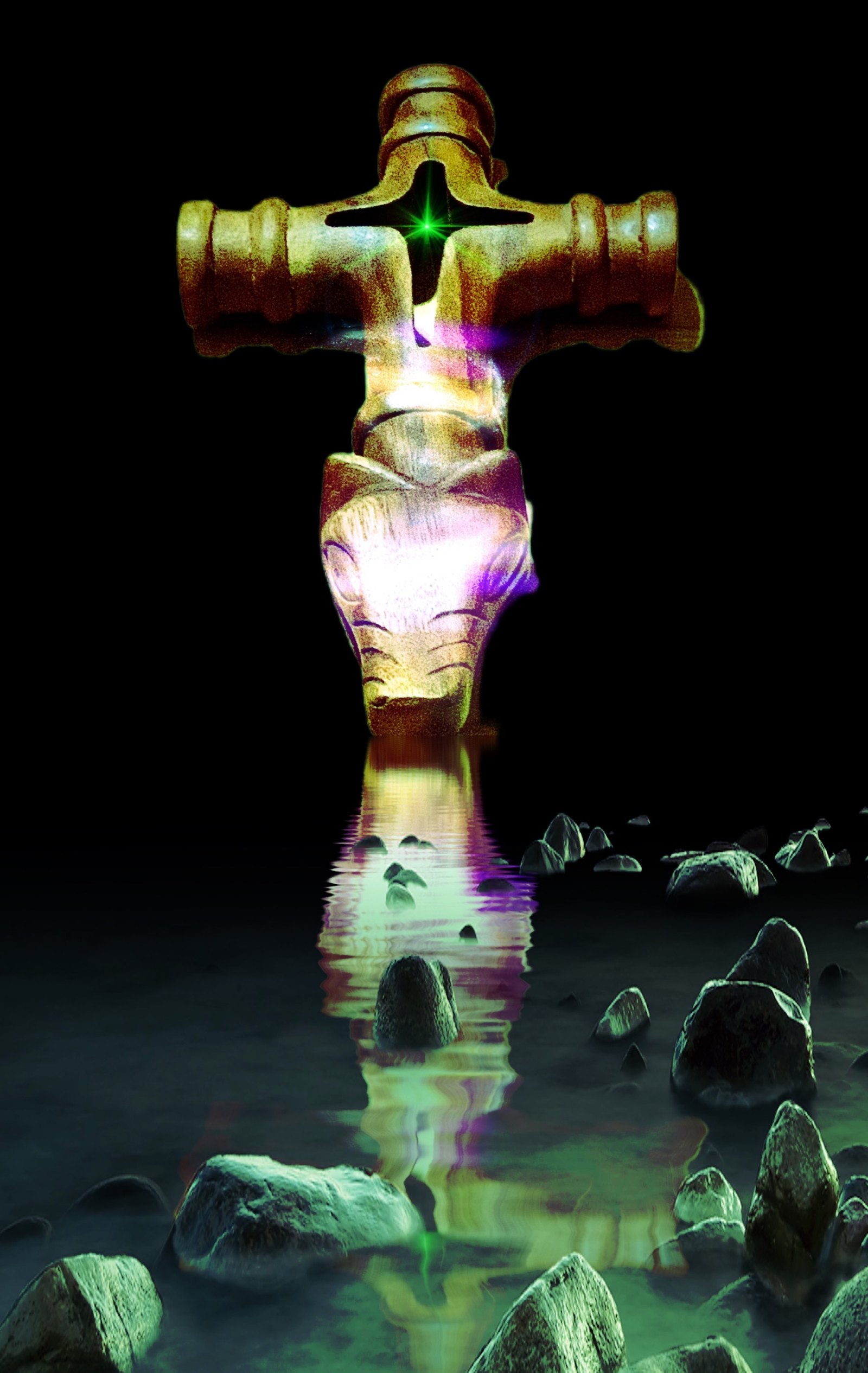
Protection is one of humanity's oldest requests to shamanic practice. Before anyone asked for bodily support, people asked for protection — from what they sensed before they could name it. The wolf appears in almost every major shamanic culture as a guardian spirit. Not as a friendly companion. As a being who keeps watch while others rest.
This article deepens a theme from the wolf overview "The Wolf as Power Animal · the Great Wolf in three cultural spheres". It examines protection as a specific function — and shows how it was shaped differently in each of the three strands of the Great Wolf.
What protection means in a shamanic sense
Protection in shamanic understanding is not the same as defence. A wall protects by separating. A wolf protects by perceiving, discerning, and intervening only where something truly does not belong. The quality of this wakefulness is the subject. Without wakefulness, no protection. With wakefulness, force is often not needed — the clarity of presence is enough.
In each of the three major cultural spheres at the centre of Shamanic Worlds, the wolf has found his own form for this.
The eight protective qualities of the wolf
Whoever calls the wolf as guardian does not call an abstract image. They call a set of concrete qualities, all drawn from the observation of real wolves in nature. The following eight appear in all three cultural spheres — with different accents:
- Wakefulness · the capacity to perceive change before it shows
- Territorial clarity · knowing where your own space ends and another's begins
- Pack bond · loyalty to those who truly belong
- Scent perception · symbolically: recognising intent beneath the surface
- Stillness · the silence from which precise action emerges
- Endurance · long staying-power without tiring
- Warning howl · the readiness to grow loud at the right moment
- Non-bitterness · protecting without lasting resentment toward what threatened
These eight qualities are no theory. They are the elements from which concrete protective practices grew in the three spheres.
A wakeful wolf does not need to bite. His presence alone changes how a situation feels. That is the core of every protective practice.
Ofuda · protection from Mitsumine and Musashi-Mitake
In the Japanese strand of the Great Wolf, the ofuda stands at the centre — a small rectangular protective tablet of paper or wood, consecrated at a Shintō shrine and then placed in the home. The wolf shrines Mitsumine-jinja and Musashi-Mitake-jinja in Japan have been known for centuries for their wolf-motif ofuda.
The logic behind it: the ofuda carries the presence of Ōguchi-no-Magami, the wolf deity of those shrines. Whoever places it invites this presence into the home. She keeps watch there as the wolf keeps watch over his territory. The effect is taken so much for granted in Japanese folk religion that it remains lived practice in many traditional households today.
The deeper connection: see the spoke "Ōkami · Japanese wolf and Shintō".
The Icelandic wolf cross
In the Northern European strand, the Icelandic wolf cross is a less known but powerful protective object. It shows a wolf biting through Thor's hammer — in classical Norse readings directed against the gods, in the shamanic reading taken differently: as wolf energy that breaks the ruling image when it has narrowed into constraint.
The wolf cross was worn in Iceland as a personal amulet. It protected its bearer on journeys, especially in regions held to be spiritually alive. The shamanic reading: it binds the wolf to one's own person, so that his wakefulness travels along.
In depth in the spoke "Icelandic wolf cross and Fenrir · read shamanically".
Loup de Baron · the African threshold guardian
In the African strand of the Great Wolf the Loup de Baron appears as a less known but specific protective figure. He belongs to the West African Vodun of the Ivory Coast (not to Caribbean voodoo). Loup de Baron is a threshold guardian — a force called when a door is to be opened or closed.
Access to Loup de Baron happens through ritualised relationship work. He is no reflex-protection switched on at need but a long-term bond that can be drawn on at particular moments. That fits the general logic of Vodun: protection is embedded in an ongoing relationship with the powers you work with.
Details in "Golden jackal, African wolf and Anubis".
Protective practice in today's daily life
What does protective practice in wolf shamanism look like concretely when someone works with it today? Three elements appear again and again in all the lines Mark and Eileen accompany:
Morning routine with the wolf
Before the day begins, the wolf is called inwardly for a brief time. This is not a long meditation. Two minutes are enough. The practitioner calls the image of the wolf, lets his wakefulness move into their own body, aligns for the day. That is the difference between a day that overruns you and a day you walk into.
Territorial clarification
Once a week, your own territory is checked energetically. Which relationships, obligations, digital channels still belong to your pack? Which have crept in and drain energy without contributing? The wolf's clarity helps make this distinction — and, where needed, to act.
Altar work
A small protective altar at the entrance or in the workspace — with ofuda, wolf cross, candle, a wolf image or a natural object from a personally meaningful place — keeps the protective function spatially anchored. It sounds naive until you do it. Then you notice: it works.
Protection is relationship
The most important point in closing: protection in wolf shamanism is not a technique you set up once and then forget. It is a relationship. The wolf protects when he is tended — when the practitioner gives him attention, honours him, listens. Whoever sets up a wolf altar and then ignores it for three months no longer has protection — only a decoration.
The relationship is the core. The practices are the tools. Both together make the difference between a life driven from outside and a life in which one's own space stays clear.
Protective practice in the Master Path
The concrete protective practices with ofuda, wolf cross and Loup de Baron are transmitted in the live events of the Wolf Shaman Master Path.