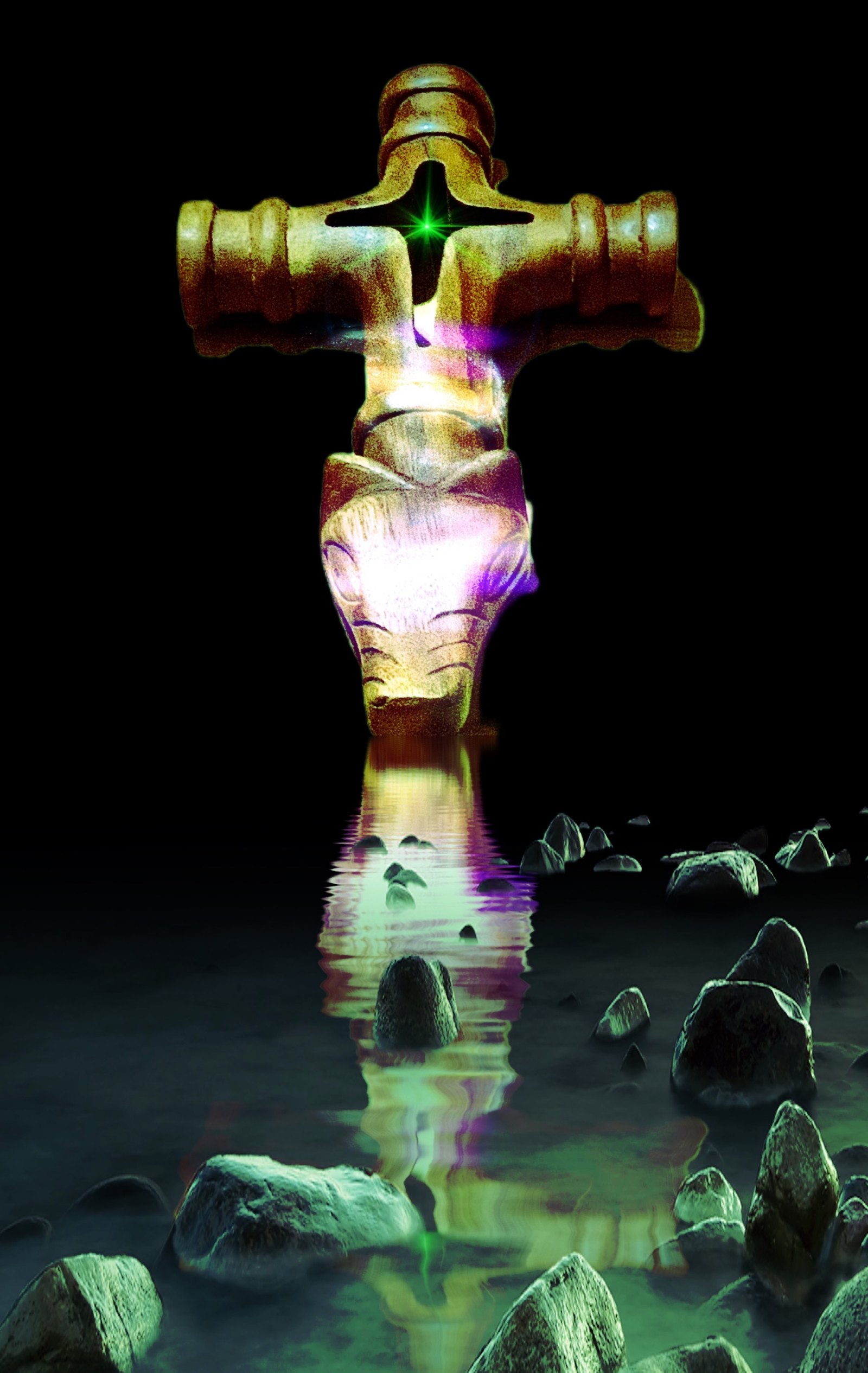
ᚠ The Icelandic Wolf Cross
and Fenrir Read Shamanically
The wolf bites through Thor's hammer. On the Icelandic wolf cross this moment is engraved · and the cross becomes a shamanic artefact. The Northern European strand of the Great Wolf · deeper than the Edda myths suggest at first glance.
When you think of the Northern European wolf, Fenrir is usually the first image — the gigantic wolf of the Edda who swallows Odin at Ragnarök. That is true as part of the story. But it overlooks a central shamanic tool from the same tradition still used in wolf-shamanic practice today: the Icelandic wolf cross. A small cross with a wolf head and a broken hammer. And this object is not just decoration. (For viewers of Vikings or readers of Neil Gaiman's Norse Mythology — the bones are familiar, but the shamanic reading goes a level deeper.)
The Icelandic wolf cross · structure and meaning
The wolf cross (Icelandic Úlfskross in some traditions) stems from the Northern European tradition of magical signs that were written down in the Icelandic Galdrabækur (books of spells) between the 16th and 18th centuries · but their roots reach much further back into the pre-Christian era.
The structure is precise:
- Cross shape · as base · symbolising the four directions and the stability of the frame
- Wolf head · in the centre or at the upper crossing · the Great Wolf himself
- Broken hammer · between the wolf's teeth · Thor's hammer Mjölnir, broken
The scene is not the sign of a victory over Thor. It is the sign of a force stronger than the hammer of order. The wolf takes the hammer's power away. This is theologically explosive · for Mjölnir is the Norse symbol for the gods' order, for law, for the boundary between chaos and cosmos. Whoever can break the hammer moves beyond that order. Or more precisely: they move as carrier of an order older than the gods.
The wolf cross shows: there is a force older than the gods. The wolf is one form of that force. Whoever wears the cross enters relationship to this pre-divine layer.
Fenrir · read shamanically
In popular reception Fenrir is the evil wolf who swallows Odin. In a shamanic reading he is something distinctly other.
According to the Edda, Fenrir is the son of Loki (the trickster god) and the giantess Angrboða. He grows up among the gods in Asgard but becomes so massive that the gods grow afraid. They try to bind him · ordinary chains fail, he breaks them. Finally the magical fetter Gleipnir binds him, forged from impossible things: the sound of a cat's footfall, the beard of a woman, the roots of a mountain, the sinews of a bear, the breath of a fish, the spittle of a bird.
This fetter is magical · it works not by physical strength but by combining paradoxes. Fenrir stays bound until the end of times. At Ragnarök he tears himself loose and devours Odin.
For a shamanic reading, three points are central:
- Fenrir is not evil. He is mighty · that is something different. The gods bind him not because he is bad but because they fear him. Their fear leads to the binding. That is a shamanic pattern: what we fear, we bind · and so lose the connection to it.
- The fetter is paradoxical. Gleipnir works with things that do not exist (the beard of a woman, etc.). Shamanically: what binds us is often itself illusory · it holds us only as long as we carry the illusion.
- Fenrir breaks free at Ragnarök. That sounds apocalyptic, but in a shamanic reading it is liberation. What was bound returns. The suppressed wildness comes to light. Odin is devoured · meaning: the old order makes room for the new.
In wolf-shamanic practice, Fenrir often meets you in threshold phases. Someone comes to a point where old structures no longer carry · there is the wolf who breaks the fetters. This is not destructive power in a moral sense · it is transformative.
The wolf cross as shamanic artefact
In Dr. Mark Hosak's wolf shamanism, the Icelandic wolf cross is not only symbol · it is a ritual tool. The function is clearly outlined:
"One example of such an artefact is the Icelandic wolf cross, on which the wolf bites through Thor's hammer and thus takes his power. Mere possession of the artefact has only minor effect. Much more important is to bind the artefact as an interface between the Great Wolf and the bearer within a shamanic ritual. Then the artefact can work as protection from negative influences or be used for matching rituals."
The crucial insight: the cross alone is a piece of metal. Its power unfolds only through ritual binding. This is a universal shamanic principle · ofuda in Japan (the wolf paper amulets from Mitsumine) also work only through embedding in practice, voodoo artefacts also need the binding through vèvè and ritual.
How the wolf cross is worked with
Without going into ritual details that belong inside initiations, the basic functions of the wolf cross can be named:
- Protection artefact · worn or placed at the workspace, active after ritual binding as threshold marker
- Focal point in trance journeys to the Great Wolf · the physical object as anchor
- Support in situations that need to cut through old fetters · Fenrir quality becomes activatable
- Pack sign · among practitioners of the wolf-shamanic lineage the wolf cross becomes an outer mark of inner connection
The arc back to the Great Wolf
The Northern European element of the Great Wolf is not "Norse religion" in the academic sense of religious studies. It is one strand of a cross-continental wolf shamanism. Ōkami at Mitsumine Shrine in Japan guards the home with his ofuda. Anubis guards the threshold to the realm of the dead in Egypt. The Loup de Baron on the Ivory Coast guards against evil spirits. And Fenrir in the Northern European strand guards the boundary between the old and the new order · the wolf cross makes this guardianship a tangible artefact.
Mark Hosak's wolf-shamanic lineage works with all three strands as equals. Whoever feels drawn to the Great Wolf eventually gains access to the wolf cross too. It is the most tangible of the three artefacts (ofuda is paper, Loup de Baron is more spirit-being than physical object) · making the Northern European strand particularly accessible.
A short caution about handling
The Icelandic wolf cross is available in various neopagan and esoteric online shops as jewellery. Buying it is the easy part · ritual activation is the decisive one. Without the binding to the Great Wolf, the cross's effect is limited.
Second point: the wolf cross has nothing to do with politically right-wing groups who sometimes misuse Germanic-pagan symbols. The wolf cross in wolf shamanism stands for shamanic connection across cultures · not for ancestral purity or ethnic belonging. The Great Wolf is for all who feel drawn to him.
The wolf cross in the Master Path
The ritual binding of the wolf cross with the Great Wolf happens in the live events of the Wolf Shaman Master Path. Together with the other strands · Ōkami and golden jackal/Loup de Baron.